Maritime Safety Culture: How to Build Strong Near-Miss Reporting On Board
A strong safety culture shows up in everyday moments on board. This guide covers what the ISM Code and IMO near-miss guidance ask for, and the practical steps fleets use to build open, confident reporting on every vessel.
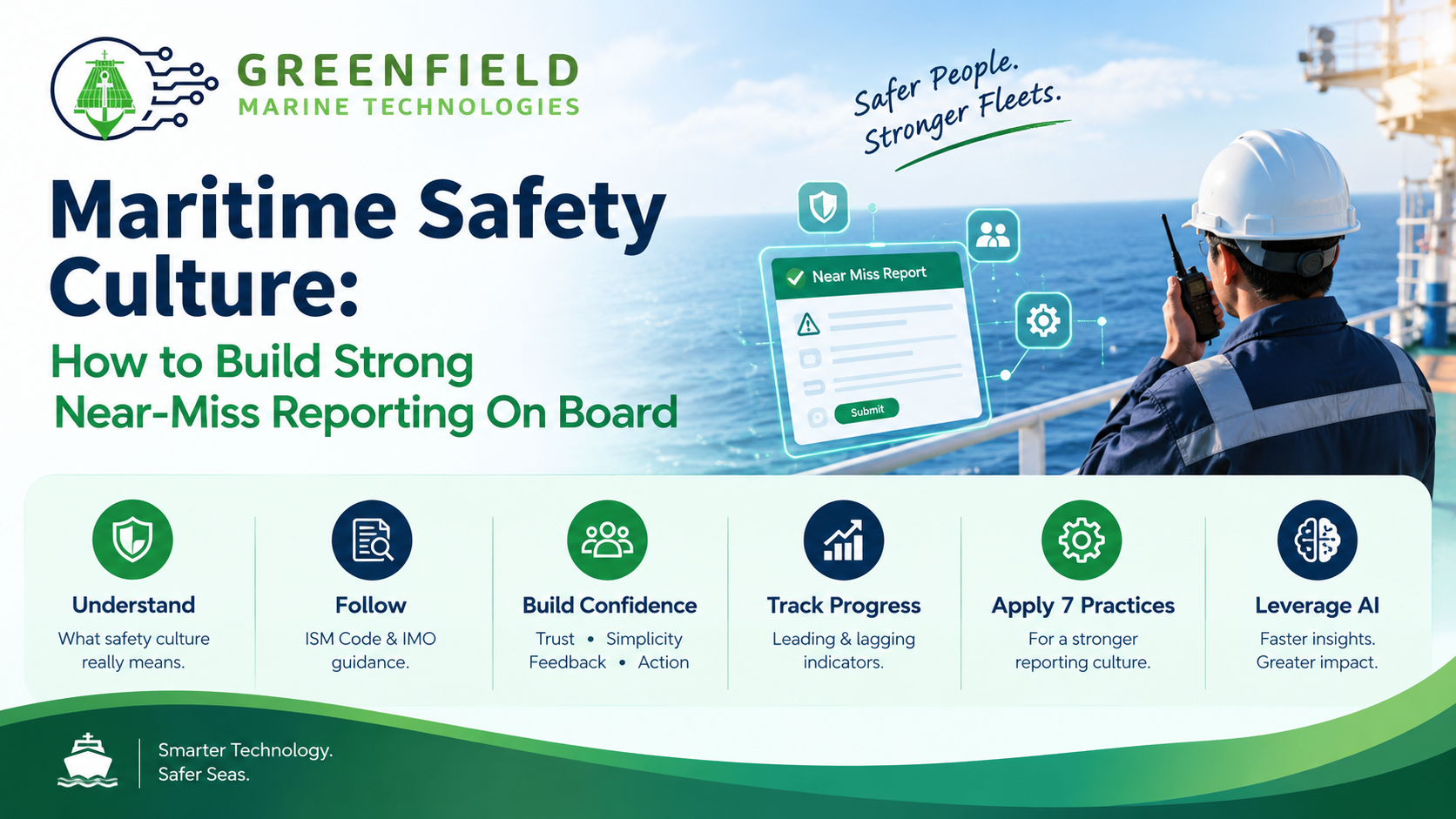
A strong safety culture is one of the most valuable assets a shipping company can have. It shows in everyday moments: a deck cadet flagging a worn mooring line, an engineer sharing a close call from the engine room, a master thanking a crew member for speaking up.
This guide explains what maritime safety culture means, what the ISM Code and IMO guidance set out, and the practical steps leading fleets use to build open, confident reporting on every vessel.
What is maritime safety culture?
Safety culture is the shared set of attitudes and habits that guide how people work every day, on every watch. Rules set the foundation; culture brings them to life.
The clearest sign of a healthy safety culture is open reporting. When crew members share hazards, observations and near misses freely, the whole fleet learns early, while improvements are simple and inexpensive to make.
What the ISM Code and IMO guidance set out
Section 9 of the ISM Code requires every safety management system to include procedures for reporting non-conformities, accidents and hazardous occurrences to the company, so they can be investigated and analysed to improve safety and pollution prevention.
IMO's guidance on near-miss reporting (MSC-MEPC.7/Circ.7) builds on this. It treats investigating near misses as part of the hazardous occurrences requirement and describes three ideas every operator can put into practice:
- What a near miss is: a sequence of events or conditions that could have caused a loss, where the loss was avoided by a fortunate break in the chain.
- Just culture: an atmosphere of trust in which people feel confident sharing safety information.
- Clear commitments: companies define when they guarantee a non-punitive outcome and confidentiality, and train everyone involved on that approach.
Together, these set a clear direction: a reporting system supported by trust.
What makes crews confident to report
Fleets with thriving reporting cultures tend to share the same foundations:
- Trust. Crews report openly when they know honest reports are welcomed and handled fairly.
- Simplicity. Short, easy forms fit naturally into a busy watch.
- Feedback. A reply from ashore shows that every report is read and valued.
- Visible action. Seeing a reported hazard fixed is a strong encouragement to report again.
- Fresh eyes. Regular safety walks and peer discussions help crews spot hazards in familiar routines.
- Quality focus. Valuing useful observations over volume keeps reports meaningful.
Leading and lagging safety indicators
Lagging indicators measure outcomes, such as injuries, incidents and port state control results. They are an important record of performance.
Leading indicators measure the proactive activity that builds safety every day. Useful examples include:
- Hazard and near-miss reports per vessel, tracked as a trend
- The share of reports that receive feedback, and how quickly
- Average time to close corrective actions
- Training and drill completion rates
- Lessons learned shared across the fleet
Tracking both gives fleet managers a complete picture, with leading indicators showing progress as it happens.
Seven practices of fleets with strong reporting cultures
- Make reporting quick. Use simple forms that work on a phone and do not depend on a good internet connection at sea.
- Write down your just culture policy. Explain clearly how reports are protected, and share it during familiarisation as well as in the SMS manual.
- Respond to every report. A short, personal acknowledgement from ashore encourages people to keep reporting.
- Close the loop visibly. Tell the crew what changed because of their report, and share the lesson with the rest of the fleet.
- Turn real reports into training. Your own near misses make highly relevant toolbox talks and drills.
- Lead by example. When the master, chief engineer and DPA report hazards themselves, the rest of the crew follows.
- Recognise good reporting. Celebrate the most useful observations and the people behind them.
How AI supports the reporting loop
AI adds value by making each step of the reporting loop faster and easier:
- Sorting and prioritising reports so important hazards reach the right person quickly
- Spotting patterns across hundreds of reports and many vessels
- Drafting feedback and turning lessons into training material so learning reaches crews sooner
- Answering crew questions about company procedures in plain language, on board
The best results come when AI works alongside experienced people. Technology brings speed and scale, while officers and managers bring judgement, investigation skills and trust.
Safety culture and the "S" in ESG
ESG covers environmental, social and governance performance. The Social pillar includes the health and safety of the people doing the work, and at sea that means seafarers.
A mature reporting culture produces exactly the evidence investors, charterers and vetting teams value: trends in leading indicators, actions closed and lessons shared. Some operators also link crew engagement with environmental initiatives, connecting safety participation with sustainability goals.
A quick self-check for fleet managers
Ask yourself:
- Can a crew member report a hazard in about a minute, even without internet?
- Does every report receive a reply from ashore?
- Can you name a recent improvement made because of a crew report?
- Is your just culture policy written down and explained on board?
- Do you track leading indicators by vessel?
- Are lessons from one vessel shared with the whole fleet?
Every yes is a strength to build on, and every not yet is a clear next step.
Frequently asked questions
What is a near miss at sea? A near miss is a sequence of events or conditions that could have caused injury, damage or pollution, where the loss was avoided by a fortunate break in the chain of events.
Does the ISM Code require near-miss reporting? Section 9 of the ISM Code requires procedures for reporting and analysing non-conformities, accidents and hazardous occurrences. IMO guidance treats near misses as part of hazardous occurrences.
What is just culture in shipping? Just culture is an approach in which people report errors and safety concerns with confidence that they will be treated fairly, while companies clearly define expected standards of behaviour.
What is the difference between leading and lagging safety indicators? Lagging indicators measure outcomes that have already happened, such as injuries and incidents. Leading indicators measure the proactive activities that build safety, such as reporting rates, feedback and training completion.